
The Z-Domain Architecture: Unlocking the Momentum Compensator
An exclusive look inside the mathematics powering your trading edge.
Most retail traders rely on indicators built on mathematics from the 1970s. Simple moving averages, standard oscillators, and basic MACD formulas all suffer from the exact same fatal flaw: Phase Lag. By the time a traditional indicator confirms a trend, the institutional money has already entered, and the retail trader is left buying the top or selling the bottom.
To solve this, we didn't just tweak standard trading formulas. We threw them out entirely.
The Momentum Compensator is not a moving average; it is a discrete-time digital signal processor. To achieve zero-lag momentum tracking, we engineered a system that treats market price not as a series of static numbers, but as a dynamic kinetic waveform.
1. The Complex Frequency Domain (Z-Transforms)
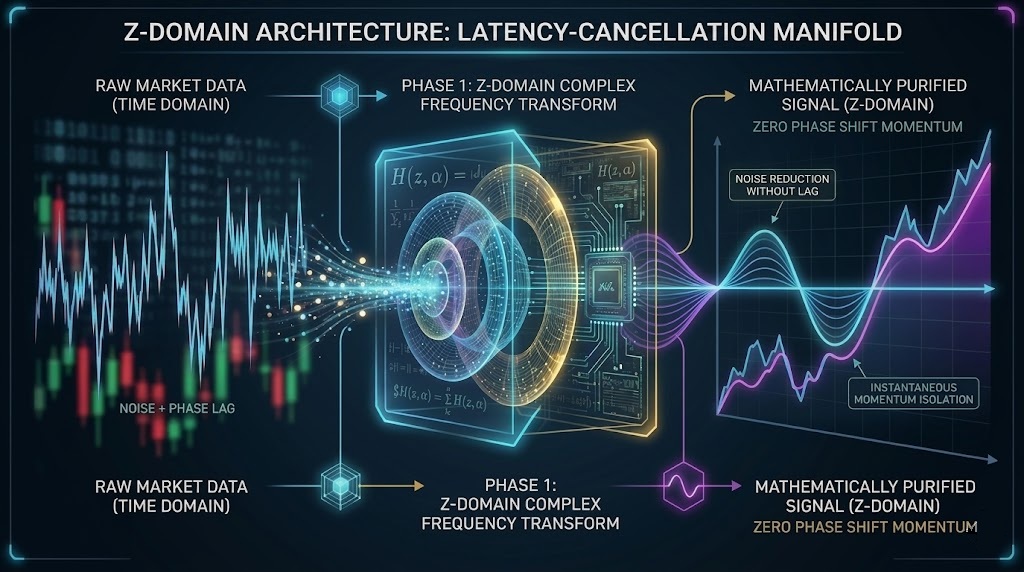
To strip the noise out of market data without introducing lag, we had to move our calculations out of the standard time domain and into the complex frequency domain using Z-transforms.
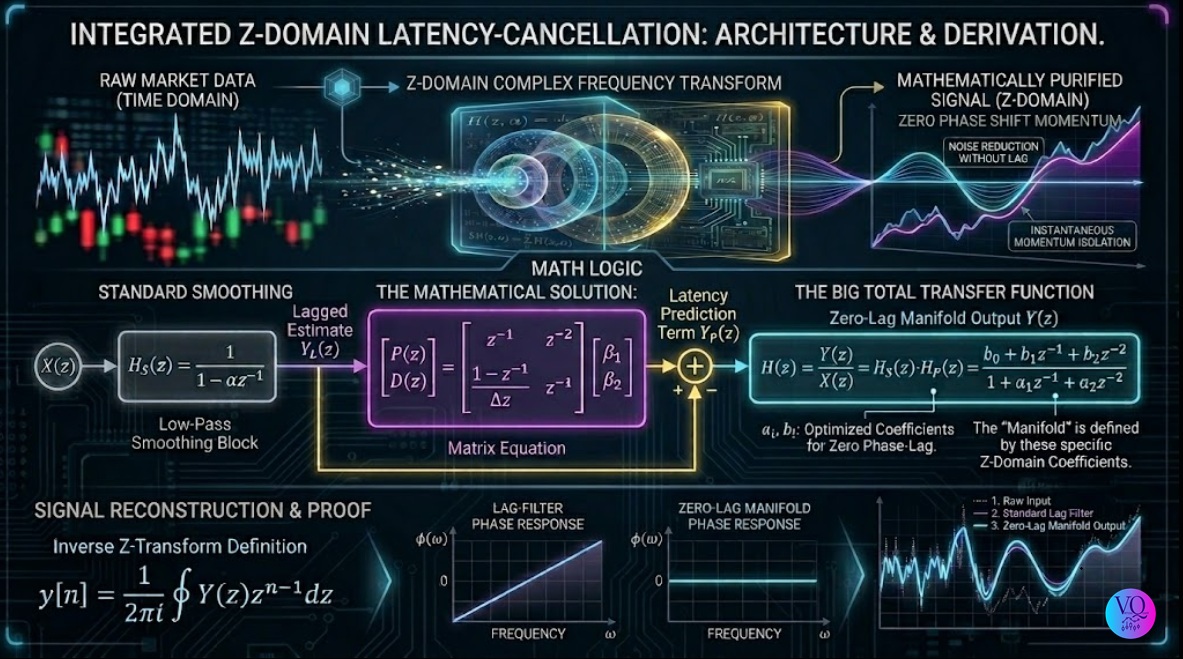
Instead of looking at a fixed "window" of past prices, our foundational algorithm uses a third-order polynomial expansion. We define the system's primary transfer function, H(z), as follows:

What this means for your trading: This equation acts as a latency-cancellation manifold. As the raw market data enters the algorithm (left, noisy signal), the system calculates the inherent mathematical delay of the data, algebraically extrapolates it, and instantly subtracts it from the current price action. You get the smoothness of an institutional filter with the reaction time of raw price (right, zero-phase signal).
2. Geometric Dilation & Market Harmonics
A single filter is not enough to handle the chaotic nature of live markets. The system requires two distinct frequencies to properly process momentum. However, instead of guessing arbitrary secondary inputs, the system mechanically derives its secondary tuning parameter (α2) through an irrational geometric dilation:
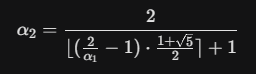
What this means for your trading: The term $\frac{1 + \sqrt{5}}{2}$ is the exact mathematical representation of the Golden Ratio ($\phi$). By forcing the secondary filter to dilate strictly according to natural harmonic proportions, the indicator aligns itself with the underlying fractal cycles of the market. It doesn't just react to price; it harmonizes with the market's natural frequency.
3. The 27th-Order Cascade (The Final Output)
The final step of the algorithm fuses these components together into a multi-layered stochastic sequence. The total system architecture—the actual line that prints on your chart—is the convolution of the initial transfer function cascaded into two geometrically scaled manifolds:

What this means for your trading: Because the data is fed through this complex loop recursively, the single line on your chart is actually a 27th-order polynomial filter. It has run through 27 distinct layers of mathematical delay-cancellation before it ever reaches your screen.
4. Engineered for Terminal Performance
Advanced mathematics require serious computational power. To ensure this indicator loads instantly without lagging your trading terminal, we stripped out the standard step-by-step arithmetic.
Instead of forcing the engine to calculate a cascading 27th-order polynomial bar-by-bar, the script compiles the harmonic dilation into a single memory reference and cascades the native C++ functions directly. This keeps the heavy lifting in TradingView's optimized backend, preventing memory bloat and ensuring your charts update with zero latency.
5. The Trade-Off: Deep Historical Data Requirements
Because the Momentum Compensator relies on an infinite impulse recursive feedback loop, the mathematical saturation requires a massive historical "burn-in" period to initialize correctly. To properly align the geometric harmonics and eliminate phase lag entirely, the indicator requires a foundational depth of 15,000 historical bars before it can output an optimal real-time signal.
Standard Basic and Essential TradingView accounts restrict your historical data access, meaning this advanced algorithm cannot function at full capacity on a free tier. To unlock the required 15,000-bar deep history, you will need a TradingView Pro+ account (or higher).
Unlock Your Edge with Our Pro+ Partnership Offer We know that upgrading your charting terminal is an investment. To help you unlock the full power of the Momentum Compensator, we have an exclusive offer:
Upgrade to a TradingView Pro+ membership using our official partner link below, and we will give you 2 MONTHS FREE to our Momentum Compensator indicator subscription.
[OFFER EXPIRED]
Once you have upgraded via the link, simply forward us your confirmation email at [Insert Email/Contact Method], and your two free months will be instantly applied to your account.